.webp)
9 Future-Proof Career Prep Strategies for Homeschooled Teens
9 Future-Proof Career Prep Strategies for Homeschooled Teens
9 Future-Proof Career Prep Strategies for Homeschooled Teens
The old career prep playbook is broken.
For decades, the path was simple: get good grades, score well on the SAT, get into college, graduate, and land a job. Parents stuck to this formula because it worked—for them.
But the world changed. The formula didn’t.
The education system still optimizes for compliance and college admissions. But the job market now rewards proof of ability. Employers want to know what you can do—not where you went. That’s why more than 1 in 3 companies are dropping degree requirements. It’s why 17-year-olds with welding certificates are landing $70K offers. And it’s why a portfolio of real work now matters more than a polished transcript.
A decade ago, I founded Praxis, a year-long career launch program that helps young adults skip college and go straight into apprenticeships with fast-growing startups. At the time, it was considered contrarian—irresponsible, even—to suggest there was any path to success besides a four-year degree. That’s no longer true.
Now with OpenEd, we’re going upstream—helping families design an education from the ground up that actually prepares kids for a future defined by creativity, adaptability, and proof of work. We call it open education—a flexible, student-driven, real-world approach to learning that meets this new era head-on.
Of course, in 2025, you can’t talk about the future of work without talking about AI.
Depending on who you ask, AI is either a magic productivity machine—or an economic asteroid that’s about to wipe out entry-level jobs. Some companies are already using AI to streamline hiring, automate copywriting, and even replace junior coders. It’s not nothing. But the fear can distract from the deeper point.
Milton Friedman once observed that giving workers spoons instead of shovels doesn’t make a society richer—it just makes the work slower. Technology, when used well, frees people to solve higher-leverage problems. Until there are no problems left in the world, the world will need problem-solvers.
That’s the real job prep. More than degrees, what matters today is the ability to spot a challenge, create value, and earn trust. And there are many ways to do that.
We hand-picked nine individuals who are GOATED in their respective fields—career coaches, entrepreneurs, educators, and artists—and distilled their career advice for an uncertain future.
While each one is different, they all answer the same basic question:
How do I build a life—and career—by solving real problems in the real world?
As a teen or a parent, you don’t need to follow all of them. Just pick the one or two that fit your family’s vision, and start designing your own path forward.
You can also try our interactive career prep advisor – get personalized recommendations:
1. Ken Coleman: Stop Building Well-Rounded Kids
What the old playbook gets wrong: Pushing kids to be competent at everything instead of excellent at something.
“I'm so sick of hearing this: ‘I want a well-rounded kid,’” says Ken Coleman, host of Front Row Seat at Ramsey Solutions. “Nobody goes to Home Depot and asks for a well-rounded sander. The tools that get the job done have an edge to them.”
Ken’s core message is that kids don’t thrive when they spend most of their time improving from a 3 to a 5 on a 10-point scale. “The world doesn’t pay for fives,” he says. “The soul doesn’t thrive doing fives. The world pays for nines and tens.”
Instead of obsessing over weaknesses, he encourages parents to help their kids lean into their strengths—what he calls their “Three Wires”:
- Talent – what you do best
- Passion – what you love doing
- Mission – the results you want to produce
If your child uses what they do best to do work they love that creates results they care about, they’re on the right track—even if they bring home a C in math.
“If they did their best and got a C, guess what we say at our house? Nice job. You’re never going to do that after school. No one’s going to pay you to do that.”
What employers actually want:
Not degrees, not GPA, not well-roundedness. “They want coachability, character, and potential,” Ken says. “Companies know they’ll need to train new hires. They just want to know you’ve got the raw material—and that you’re someone they can trust.”
Key Resources:
- Find the Work You're Wired to Do – Ken’s latest book (student and adult editions)
- Get Clear Career Assessment (Student Version) – Ken’s tool for identifying strengths and ideal career paths (free with the book)
- CliftonStrengths Assessment – Build on natural talents rather than fix weaknesses
- CareerOneStop Self-Assessments – Department of Labor tools for career planning
- O*NET Interest Profiler – Match interests to career paths and required education
2. Aaron Osmond: Certification Plus Strategic Networking
What the old playbook gets wrong: Assuming degrees signal job readiness when they mostly prove endurance.
"Industry has not been satisfied for decades with the quality of potential tech workers coming out of the education system," says Aaron Osmond, CEO of Knowledge Pillars and long-time tech executive. “Degrees prove students can finish things. They don’t prove they know how to use the tools that employers actually need.”
Osmond built his own tech career without a degree—starting as a WordPerfect receptionist thanks to a family connection. But he didn’t coast on that opportunity. He taught himself database skills on the side, earned trust, and moved up. That’s why his approach emphasizes two parallel tracks: industry certification to validate hard skills, and strategic networking to activate opportunity.
“Even the best certification won’t land you a job if no one knows you have it. But a connection alone won’t help if you can’t deliver once you’re in the door.”
This blend of signal and substance is what Knowledge Pillars aims to deliver. Their live, in-browser certification exams assess students in real time using the actual tools (e.g. WordPress, Python, JavaScript), offering proof that’s impossible to fake—and recognized by employers. [Note: Knowledge Pillars courses are available to teens in OpenEd at no cost.]
What employers actually want:
Real-world skills, critical thinking, and a portfolio that proves it. As Osmond puts it: "AI is just a tool. If you don't understand how it works, you can't use it well. Problem solving and adaptability still win."
Key Resources:
- Knowledge Pillars Certifications – Hands-on, in-browser certification exams in coding and web development
- GitHub – Host and showcase technical projects with public portfolio links
- AWS Certifications – Cloud computing credentials (also includes links to Azure and Google Cloud)
- LinkedIn Learning – Courses with certificates that are visible to recruiters
- OpenEd Podcast: The Truth About Tech Careers (No Degree Required)
3. Rose Ybaben: The Elimination Method
What the old playbook gets wrong: Pressuring teens to "find their passion" early—when most don’t even know what they don’t like yet.
“Great! Now you know what you don’t want to do,” Rose Ybaben told her son after he quit a miserable mailroom job at an outdoor gear company. “And that’s just as important as knowing what you want to do.”
Ybaben, founder of Soaring2College and a former high school counselor, has spent over 15 years guiding families through post–high school planning. Her framework flips the pressure-filled question of “what are you going to be?” into something more achievable: a process of eliminating what doesn’t fit.
“Career paths aren’t linear. They’re elimination rounds. Every ‘no’ helps you get to a better ‘yes.’”
Rather than obsessing over one perfect major or career, she helps teens experiment—then reflect. That reflection becomes fuel for smarter next steps, whether that means changing course, skipping college, or building a portfolio.
Ybaben also emphasizes debt-free planning. “You don’t have to go to an Ivy League school,” she says. “You don’t have to come out $200,000 in debt to get a great education.”
What the new playbook looks like:
Start with self-discovery. Try new things. Use what you don’t enjoy to narrow down the possibilities. Then revisit the plan regularly. Nothing is final—not even college.
Key Resources:
- Soaring2College Counseling – Individualized guidance based on elimination-based exploration
- CareerOneStop Self-Assessments – Interest, skills, and values discovery
- O*NET Interest Profiler – Career matching based on personality
- BigFuture by College Board – Compare careers, majors, and college options
- OpenEd Academy Virtual High School – Design a personalized diploma path aligned to life goals
- EF Gap Year Programs – Structured post-grad exploration and skill-building
- Community College Dual Enrollment – Academic and technical pathways for high schoolers
4. Mike Rowe: AI-Proof Skilled Trades
What the old playbook gets wrong: Promoting knowledge work as “safer” while ignoring the 4 of skilled trades.
On July 22, 2025, business mogul Codie Sanchez posted this sobering observation:
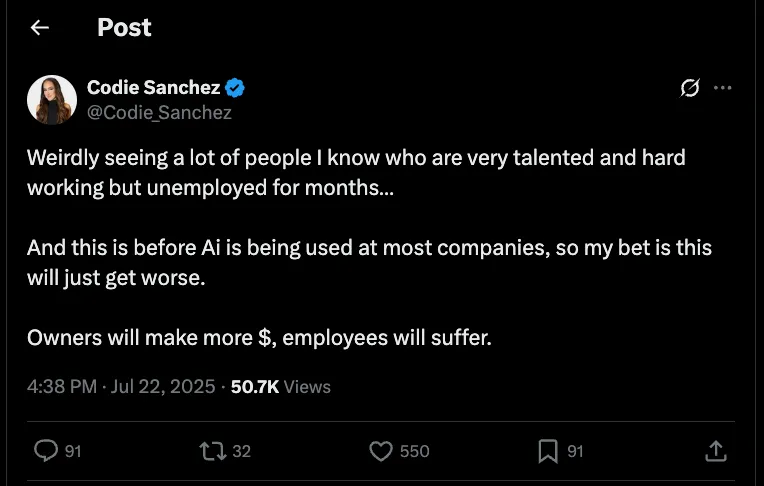
She’s not wrong. In sectors where talent is replaceable, commoditized, or easily outsourced to algorithms, the bottom rungs of the career ladder are shaking. Many young professionals are stuck in a liminal zone—overqualified, under-experienced, and squeezed by automation.
But not all jobs are on the chopping block.
“AI is coming for the coders,” says Mike Rowe, host of Dirty Jobs and founder of the Mike Rowe Works Foundation. “They’re not coming for the welders. They’re not coming for the electricians.”
Rowe’s message is simple: the most essential work—the work that keeps the lights on, the water flowing, and the engines running—is the least likely to be outsourced or automated.
Skilled trades remain one of the most future-proof paths in the economy:
- The U.S. will need 500,000 electricians in the next few years
- The BlueForge Alliance needs 140,000 skilled tradespeople to build nuclear submarines
- The auto repair industry is short 80,000 collision repair technicians
These are jobs with six-figure ceilings, no college debt, and a clearer connection between input and output. And yet, most students never hear about them.
“The most critical jobs that allow civilized life to happen are the exact jobs struggling to recruit,” Rowe warns. “We've created a cultural disconnect between the work we need and the careers we celebrate.”
The Trades Alternative:
While traditional education pushes “college for all,” Rowe sees rising interest in apprenticeships and trade schools. His foundation’s Work Ethic Scholarship received 10x more applicants this year than last. “Something's happening,” he says. “The message is resonating.”
What the new playbook looks like:
Don’t just teach your kid to learn. Teach them to build, fix, install, weld, or wire. These careers are not only resilient—they’re indispensable.
Key Resources:
- Mike Rowe Works Foundation – Scholarships for students pursuing skilled trades
- SkillsUSA – Career competitions and leadership training in technical fields
- Apprenticeship.gov – Federal database of apprenticeship programs by trade and state
- Tooling U-SME – Online industry-aligned training for manufacturing and skilled trades
- Local Trade Unions – Search by region for apprenticeship and pre-apprenticeship pathways (no central URL)
5. Connor Boyack: Business Apprenticeships
What the old playbook gets wrong: Teaching theoretical knowledge “just in case” instead of real-world skills “just in time.”
“There are two different models of how people learn,” says Connor Boyack, author of the Tuttle Twins series and president of the Libertas Network. “The traditional school system uses a ‘just in case’ model—memorize everything just in case you need it someday. But that’s not how real learning happens. That’s not how adults operate in the real world.”
Boyack argues that what most kids need is just-in-time learning: the ability to find the right information, apply it quickly, and solve a problem when it matters. That’s why he’s bullish on business apprenticeships—and why Libertas acquired Praxis, a year-long alternative to college that combines 30 hours per week of real work with structured professional development.
“We’re creating a direct pipeline from learning to earning,” Boyack explains. “Our participants work inside real companies, solve real problems, and graduate with a portfolio—not just a diploma.”
What the new playbook looks like:
Start with intentionality. What’s the end goal? Then reverse-engineer a path that leads there. Praxis helps young people skip the lecture hall and get paid to learn while they build career capital from day one.
Apprenticeship is not a fallback—it’s a fast track.
Key Resources:
- Praxis – 10-month business apprenticeship combining paid work with career training
- Skip College (book) – Alternatives to traditional higher education
- Tuttle Twins – Economics and entrepreneurship education in story form for all ages
- Children’s Entrepreneur Market – Real-world selling and learning experiences for kids
- Be Your Future Self Now (book) – Benjamin Hardy’s book on goal-setting and future-oriented thinking guide for teens and adults
6. Michael Gibson: Entrepreneurship
What the old playbook gets wrong: Teaching students to signal competence to employers—rather than building something that proves it.
Michael Gibson, co-founder of the 1517 Fund and former director of the Thiel Fellowship, helped launch companies like Ethereum and Figma by backing young founders before they had credentials. His core insight? Credentials aren’t the same as competence—and employers are starting to notice.
“Degrees don’t prove skill,” Gibson explains. “They signal traits like persistence and conformity. But if you already have the ability—if you’re a builder, a thinker, a self-learner—you don’t need to wait for a permission slip.”
This idea fueled the Thiel Fellowship: a $100,000 grant awarded to under-20s willing to drop out of college and build something real. Far from reckless, Gibson argues it’s a corrective to a system where prestige outweighs performance and where students compete for empty credentials in hopes of standing out.
The portfolio approach:
Instead of optimizing for hireability, Gibson urges young people to optimize for proof of ability. “Find the smallest project that proves your value. Even if you work for free at first, the key is building your reputation in public—on GitHub, in your writing, or through a product.”
What the new playbook looks like:
Skip the signaling treadmill. Start small. Solve real problems. Share what you build. Then do it again.
Future-focused problems:
In his book Paper Belt on Fire, Gibson outlines the “10 unsolved problems” in energy, education, health, and infrastructure that could define the next century. He challenges young people to treat these like modern-day moonshots:
“If you solve one of these, you’ll win a Nobel Prize. You’ll change the world. You’ll matter.”
Key Resources:
- 1517 Fund – VC firm backing founders without credentials, degrees, or permission
- Thiel Fellowship – $100,000 grants for young people to build instead of attend college
- Paper Belt on Fire (book) – Gibson’s critique of higher ed and map for entrepreneurial rebellion
- AngelList – Platform to join early-stage startups or raise capital
- Y Combinator – Leading startup accelerator, accepting founders regardless of degrees
- The Network State by Balaji Srinivasan – Vision for decentralized learning, governance, and entrepreneurship
7. Ben Smallbone & Ben Kasica: The Creator Economy
What the old playbook gets wrong: Waiting for permission from gatekeepers instead of starting now and building an audience directly.
“When I moved to Hollywood,” recalls Homestead showrunner and former Skillet guitarist Ben Kasica, “a friend asked me: ‘What are you waiting for? Are you waiting for somebody to pick you?’ That hit me. No one’s going to stumble on you and hand you $5 million to make your dream film. Just start doing something. Anything. Make one thing, and you're already ahead of most people in Hollywood.”
That do-it-yourself ethos also defines Homestead director Ben Smallbone, who never went to film school. He started by making rough home movies with his siblings—including the future duo For King & Country. His education? Homeschooling by day, filmmaking by night.
The new creative path: Both filmmakers emphasize that the tools to create—and to launch a career—are now fully accessible. “There are scenes in Homestead we shot on a camera you can buy at Best Buy,” Smallbone explains. “Technology is no longer the limiter. Curiosity is.”
Their shared experience as homeschoolers gave them the freedom and time to experiment. Kasica joined a national touring band at 16. Smallbone built a body of creative work years before most kids graduate high school. “We didn’t know what the box was,” he says. “So we didn’t feel constrained by it.”
Portfolio over pedigree: The entertainment industry no longer hires based on degrees—it hires based on what you’ve made. That’s the driving idea behind Sneak on the Lot, a hands-on film education platform co-founded by Hollywood veterans Chet Thomas and Darrin Fletcher. Their virtual backlot helps students move from classroom to production set, casting actors and hiring crew directly from the platform.
A message for young creators: Don’t wait. Make something. Fail forward. Build your portfolio instead of collecting debt. You no longer need permission to start.
Key Resources:
- Sneak on the Lot — Hands-on filmmaking curriculum and virtual backlot connecting students to real jobs on real productions
- Angel Studios — A creator-led film platform where audiences decide what gets made
- NoFilmSchool — Practical guides, gear reviews, and production tips for indie filmmakers
- YouTube Creator Academy — Free tools and lessons for building and monetizing a creator channel
- MasterClass — Learn directly from Hollywood-level directors, screenwriters, and producers
- Film Freeway — A platform for submitting films to festivals and competitions worldwide
- Adobe Creative Cloud — Industry-standard editing and production software with student pricing
- Unity — Game engine used for building immersive film sets and virtual production workflows
We’ve covered a lot—from AI panic to credential collapse to the rise of the portfolio economy. But the throughline is simple: in a world defined by uncertainty, the edge belongs to those who are curious enough to start. Not wait. Not get picked. Just start. That’s the story behind Praxis. That’s the story behind OpenEd. And it’s the story behind every one of the people we featured in this guide.
So no, I’m not worried about AI taking all the jobs. I’m more interested in what you’re going to do with it. The new playbook isn’t about security—it’s about agency. Try something. Make something. Build proof. And if you’re wondering how to begin, we built OpenEd for exactly that.
Apply now—and start designing the education that actually prepares your kids for what’s next.


Subscribe to The OpenEd Daily
Join 20,000+ families receiving curated content to support personalized learning, every school day.
.png)
.png)