.webp)
.png)
Homeschooling doesn't mean what it used to
Homeschooling doesn't mean what it used to
Homeschooling doesn't mean what it used to
.avif)
Greetings Eddies!
What do you call it when your kid learns math online, history from a co-op, art at a local studio, and reading from their older sibling in the playroom?
The Texas Legislature calls it "homeschooling." But that word is doing a lot of heavy lifting these days.
Let's dive in.
THOUGHT: The Cable Bundle Problem
TREND: What PCE Means For Parents (And Teachers)
TOOL: Build Your Own Resource List
The Cable Bundle Problem
Leo Linbeck III (who sounds like he should be commanding a Swedish cavalry regiment, but is actually a Houston-based engineer with sharp takes on education) offers an clever analogy for how education is evolving:
Traditional school is like a DirecTV bundle. You get 132 channels. Take it or leave it.
Traditional homeschool is like community theater. The material might be Shakespeare, but mom and dad are handling the sets, costumes, and lighting themselves.
Today's version of homeschooling? More like Netflix plus a touring Broadway show. Professional production values. You choose what fits. No filler.
Linbeck calls this "Parent-Curated Education"—or PCE, because he's an engineer and loves a good acronym. We call it Open Education (OE, if you like). Either way, the shift is the same: parents aren't the instructors anymore. They're the curators.
Read Linbeck's full Substack post
What PCE Means for Parents (And Teachers)
Texas defined "homeschool" in 2007 as instruction "provided by the parent" and delivered "in or through the child's home." But today's families don't fit that box.
A kid might learn algebra from Khan Academy, history from Great Hearts Online, art at a local studio, and writing at a neighborhood microschool. Little of the instruction is "provided by the parent." Much of it happens outside the home.
The implication? Mom doesn't have to master every subject. She finds the masters.
And for teachers, Linbeck sees opportunity: this model lets them practice their craft in human-scale settings—tutoring, microschools, co-ops, online courses.
The old terms don't fit anymore.
Learn more about Open Education
Build Your Own Resource List
Linbeck mentions that ChatGPT can generate 50 learning resources in 20 seconds. But a generic list isn't as useful as one tailored to your family.
Here's a prompt you can copy into ChatGPT, Perplexity, or the increasingly popular Gemini (turn on deep research mode for best results):
I'm looking for educational resources for my family. Here's our situation:
Location: [Your county/city, state] Kids' ages: [e.g., 7 and 10] Current interests: [e.g., dinosaurs, Minecraft, gymnastics, drawing] Learning preferences: [e.g., hands-on, self-paced, social/group] Budget: [e.g., free only, up to $100/month, flexible]
Please find me a mix of:
- Local co-ops, microschools, or learning pods
- Online courses or platforms matching their interests
- Community classes (art, music, sports, STEM)
- Field trip destinations within 30 miles
- Tutors or specialists in our area
For each, include: name, what it offers, cost (if known), and a link.
Try it today. Reply and tell us what you found.
Tweet Of The Week
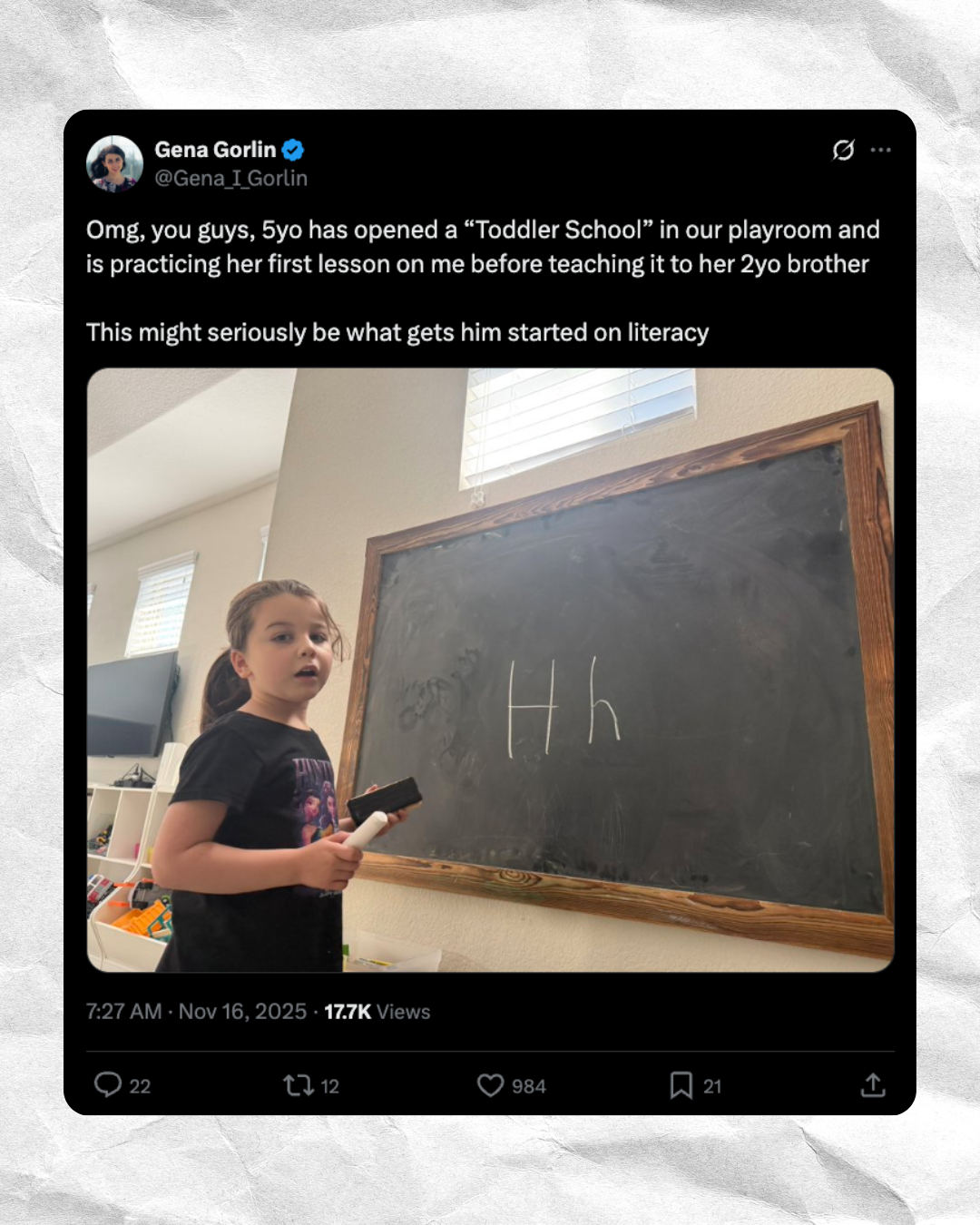
This is what happens when learning isn't confined to a classroom schedule. Kids follow their interests... and bring others along with them.


Subscribe to The OpenEd Daily
Join 17,000+ families receiving curated content to support personalized learning, every school day.
.png)
.png)
.png)